

To survive and grow, a company needs money to develop. In other words, funding.
Beyond what its operations generate, a company can rely on two types of channels: dilutive and non-dilutive financing. The difference lies in dilution, but why? And what exactly is this dilution?
What is "dilution"?
When a company is founded, its creators inject their own money into it. But there comes a time when it needs additional funds to grow.
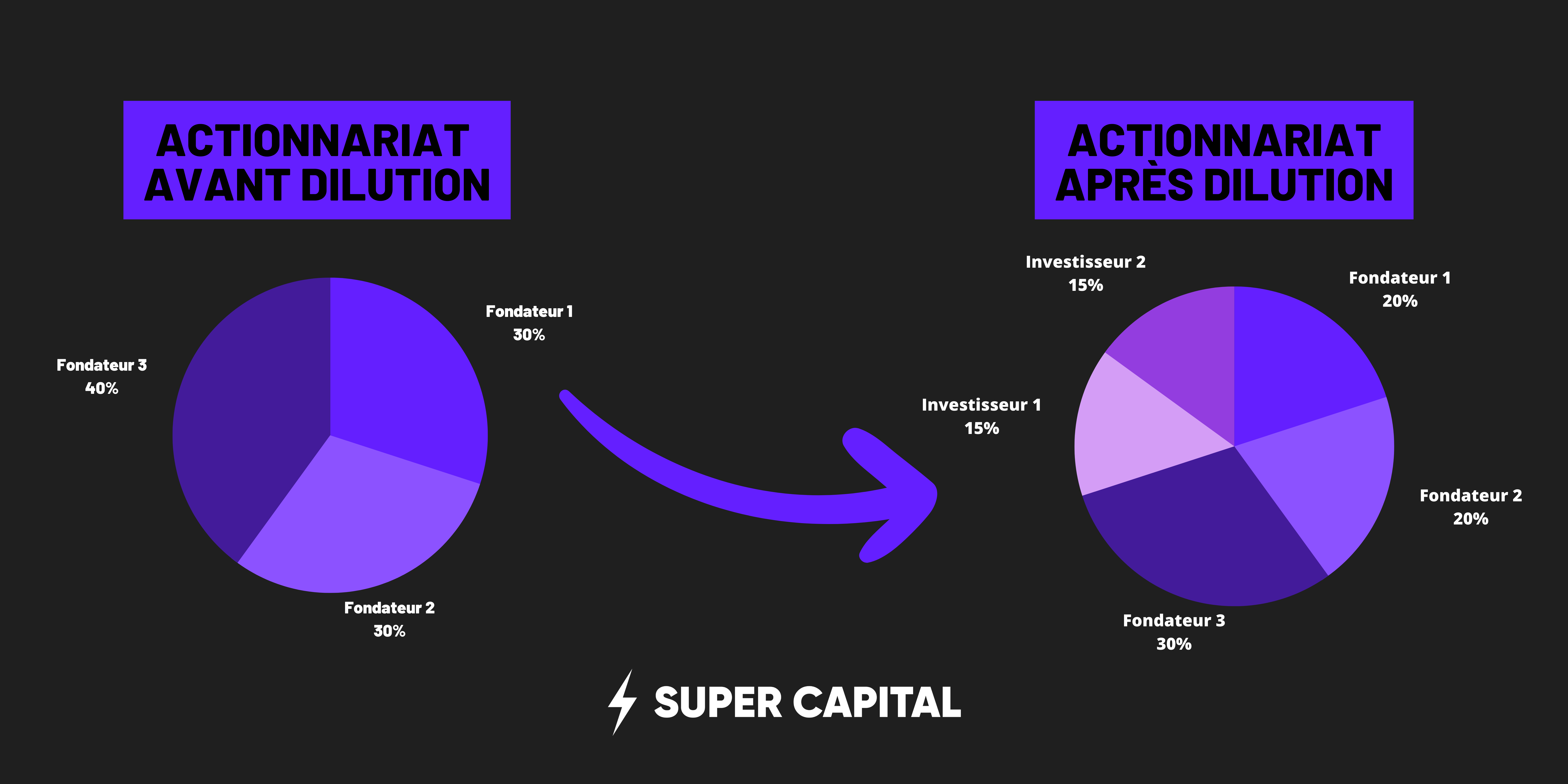
To do this, you can turn to investors who will inject additional capital in exchange for shares in the company. This is commonly known as a "dilutive fundraising" or "equity round." But in practice (because yes, it all comes at a price), the founders are no longer the sole owners of the company. This dilutes the percentage of capital held (hence "dilutive financing"—yes, it really is that simple!).
The problem? The more investors there are to share the pie (the capital), the smaller everyone's slice becomes.
What is "non-dilutive" financing?
What if, after that first round of funding, you don't want to share your pie but still want to keep enjoying it? In that case, we highly recommend looking into non-dilutive financing.
In this second option, you don't touch the company's equity; instead, you use debt. Essentially, you take out a loan from a bank that you pay back over time—much like a mortgage. This way, the company can receive funds without diluting ownership among more investors.
And that’s not the only way. To fund your business without diluting your capital, you can also use:
- government grants,
- tax incentives (such as R&D tax credits or innovative startup status),
- credit advances (such as a zero-interest loan from BPI),
- crowdfunding,
- factoring, and more.
But that’s a topic for another article…
Dilutive and non-dilutive: two sides of the same coin
Even though they are often compared, these two financing methods are not enemies! On the contrary, it is often advisable to combine them. Increasing equity (through a dilutive funding round) strengthens a company and makes it more creditworthy in the eyes of banks—making it better positioned to repay a loan. In short, this is how you can benefit from what is known as "leverage." Banks today are actually set up to support startups through dedicated "innovation" units and with the backing
of BPI.
To illustrate this: imagine a company raises funds with an investor to reach a capital of €1M. It will then be in a "stronger" position in the eyes of banks when negotiating a loan.
As for the loan amount, companies generally negotiate a borrowing equivalent to half of their equity (capital, reserves, retained earnings, and net income). To return to our example, if the company has €1M in equity and no debt, it will be able to negotiate a bank loan of approximately €500,000.
As a bonus, if the company has assets, this ratio can increase significantly!

Pretty bonus before you go: what happens in the event of bankruptcy?
When a company declares bankruptcy, liquidation begins. The company's assets must then be sold. This amount is subsequently used to repay the company's creditors.
Unfortunately, in most cases, the proceeds generated from the sale of assets are rarely enough to repay all outstanding debts. Creditors are therefore ranked by order of priority according to rules set out in mortgage law.
The company's cash will first be used to repay the company's so-called "preferred" creditors: employees, social security organizations, and the state. Banks fall into this category and will be paid first.
If the proceeds from the liquidation are not completely exhausted, other creditors such as bondholders and suppliers are next in line.
Finally, it is important to remember that shares are the least protected debt instrument in the event of bankruptcy. Therefore, shareholders are exposed to the risk of a total loss of their investment. And very often, the remaining balance for them is zero.
That’s all from us! As you have surely understood, raising both dilutive and non-dilutive capital is fundamental to maximizing your financing. At Super Capital, we encourage these concurrent dilutive and non-dilutive raises. And thanks to our 360° offer, we support you through these various stages! So don't hesitate to contact us. :)
/Plus de ressources en
Bank financing & BPI



/Let's talk about your needs